Knattspyrnufélag Reykjavíkur: Emerald City wasn’t Oz at all. It was KR Reykjavík, where a bucket‑list goal finally came true.
This was the last stop on my Icelandic Football Ground Tour. The pilgrimage to end all pixelated pilgrimages. Reykjavík. The home of Knattspyrnufélag Reykjavíkur. Or, as my Football Manager 2008–ravaged heart knows them: KR Reykjavík, the club of legends, miracles, and one embarrassingly over‑committed digital dynasty.
Because let’s be clear: this wasn’t just a team to me. This was the club where I had won 1 Champions League, 15 Leagues, 15 Cups, 15 Upper League Cups, 11 Youth League titles, 6 Youth Cups, 3 Reserve League trophies, and — perhaps most importantly — the 2014 South West England Tour Championship. A golden age. The kind of success that would get managerial statues built if it wasn’t all happening inside a 2008‑era Acer laptop whirring louder than an Xbox 360 struggling with the Red Ring of Death.
Arriving at the KR‑Völlur ground felt like closure — the dramatic final episode of one of the great human/video game relationships, up there with “Call of Duty meets Modern Warfare” or “Need for Speed meets a Vauxhall Corsa with delusions of grandeur.” Dorothy had her ruby slippers; I had my KR scarf and a car park that didn’t charge.
And suddenly I was 15 again, back in my bedroom playing on the PC, sweating over Sensible Soccer 1996/97 during a summer I absolutely should’ve spent outdoors. Fired by Manchester United and Tottenham, I was left with the glamorous managerial options of Barrow Town, Port Vale, and… KR Reykjavík. Other clubs gave me jobs. KR gave me intrigue — a curtain to pull back, a wizard to discover, and a talisman named Hilmar Björnsson. Officially valued at £150k, spiritually worth more than the Emerald City itself. We ran rampant, flying monkeys with shin pads. That was the spark. The beginning. And if I told my 15‑year‑old self that, decades later, I’d be standing on that very ground in real life? He’d have toppled backwards of his chair and spilled Sunny Delight all over his clunky 90’s keyboard.
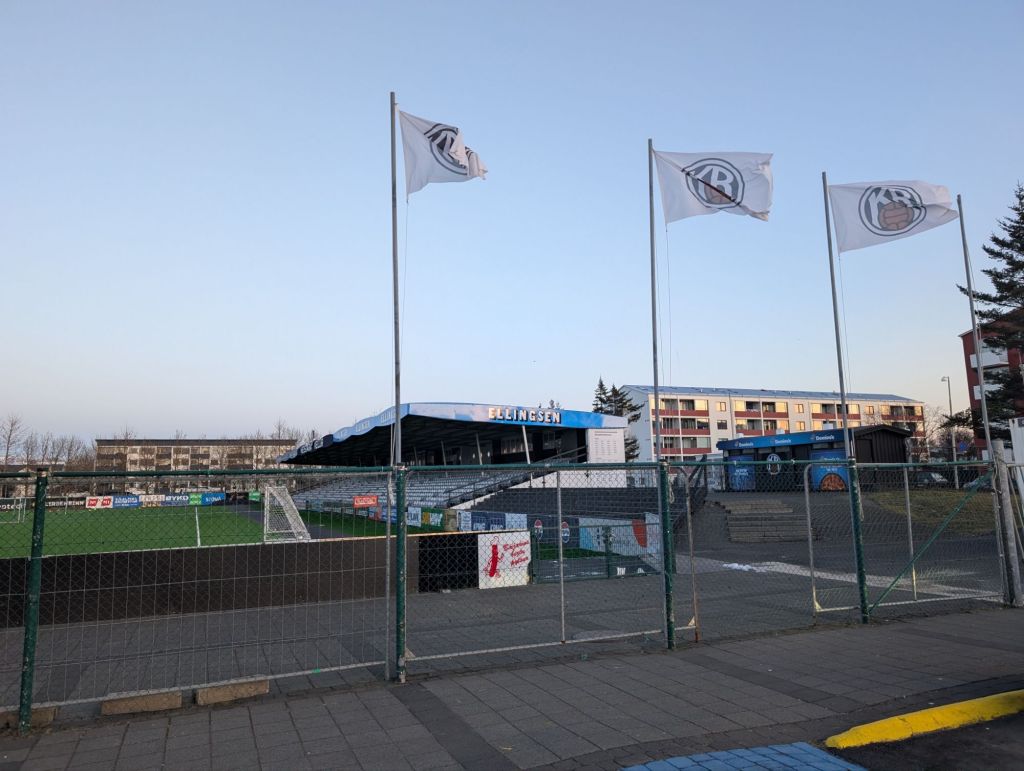
The badge above the clubhouse greets you first: two majestic letters above a retro looking brown football. Then the centenary lamp outside — a glowing orb that looks suspiciously like a Champions League ball that got bored of Geneva and emigrated north.
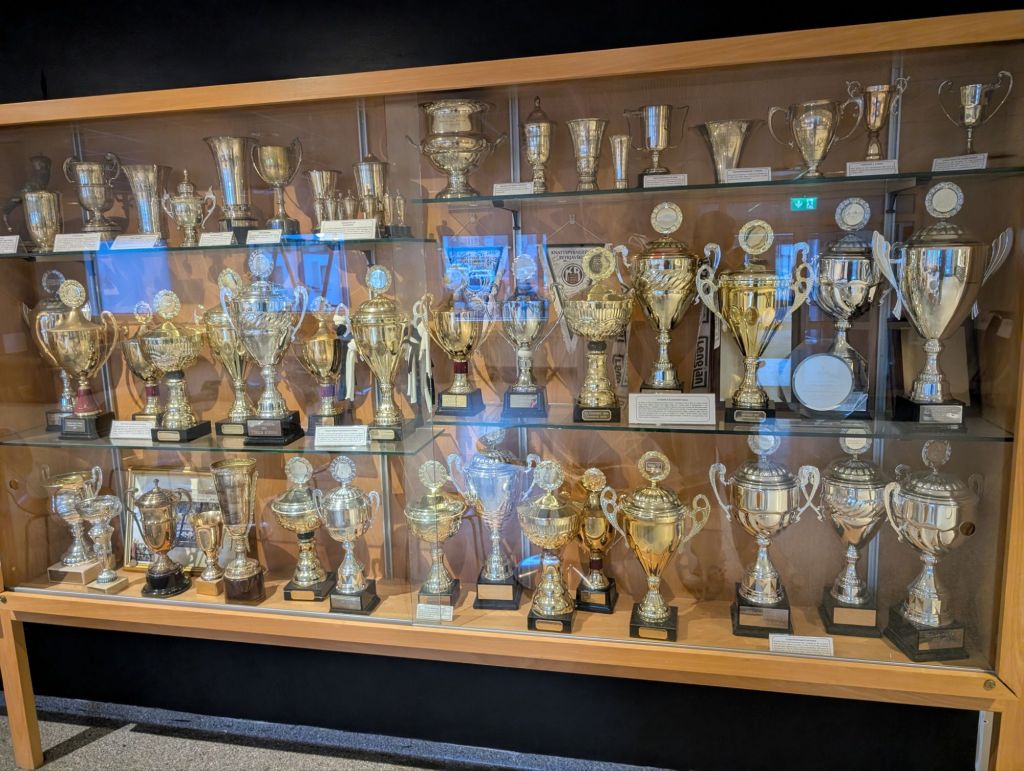
Inside, the trophy room. The biggest football collection in all of Iceland. More league titles than anyone else. There are more than a century of bragging rights on display there. On sunny days the light pours through the door and bathes the silverware in gold. It looks like the kind of radiance tourists chase the Northern Lights for weeks trying to glimpse, only for KR to serve it up, unbothered, on a Wednesday morning between 10am and lunchtime.
I wandered through corridors buzzing with history straight into the official team changing rooms. I may well have used the same toilet Hilmar Björnsson once used for pre‑match nerves. He focused his mind; I just needed a wee before my pitch walk. But spiritually? We connected through shared porcelain.
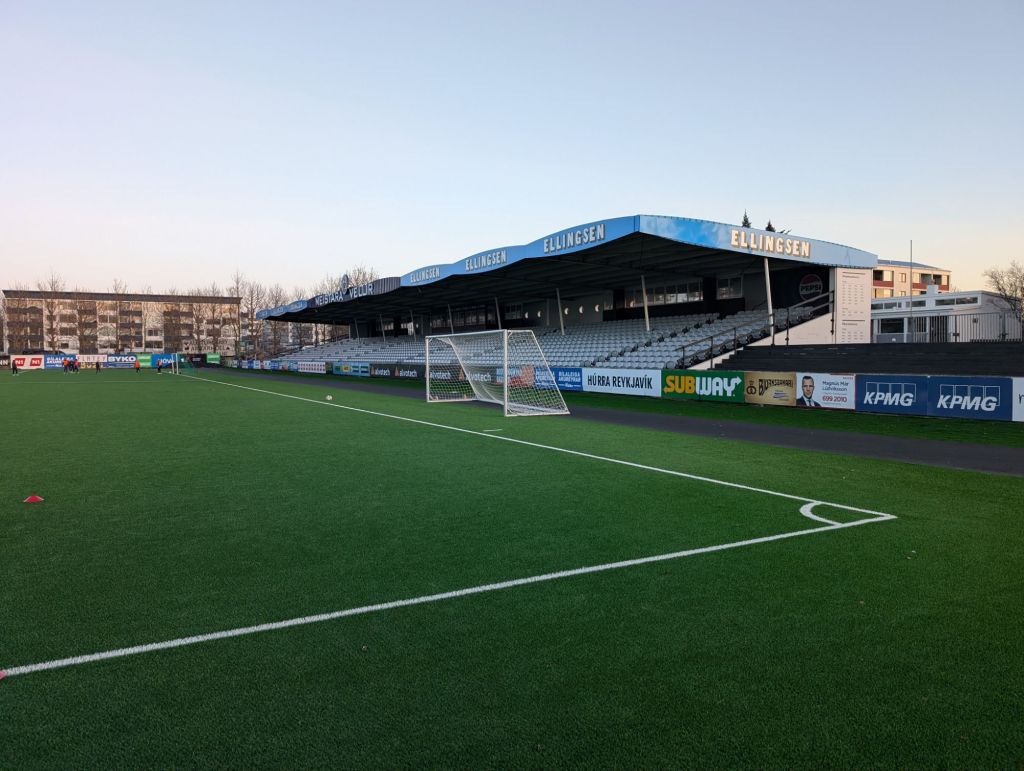
And then… the pitch. What. A. Sight. AstroTurf stretching out under the Reykjavik mountains. The stand rising neatly against the horizon. The kind of view that makes you stop mid‑stride and think, “Yes, this is exactly where my 15 league titles from Football Manager should be celebrated.” The pitch might have claimed the skin from a few kneecaps over the years, but it looked magnificent — like the Yellow Brick Road, only with more rubber pellets.
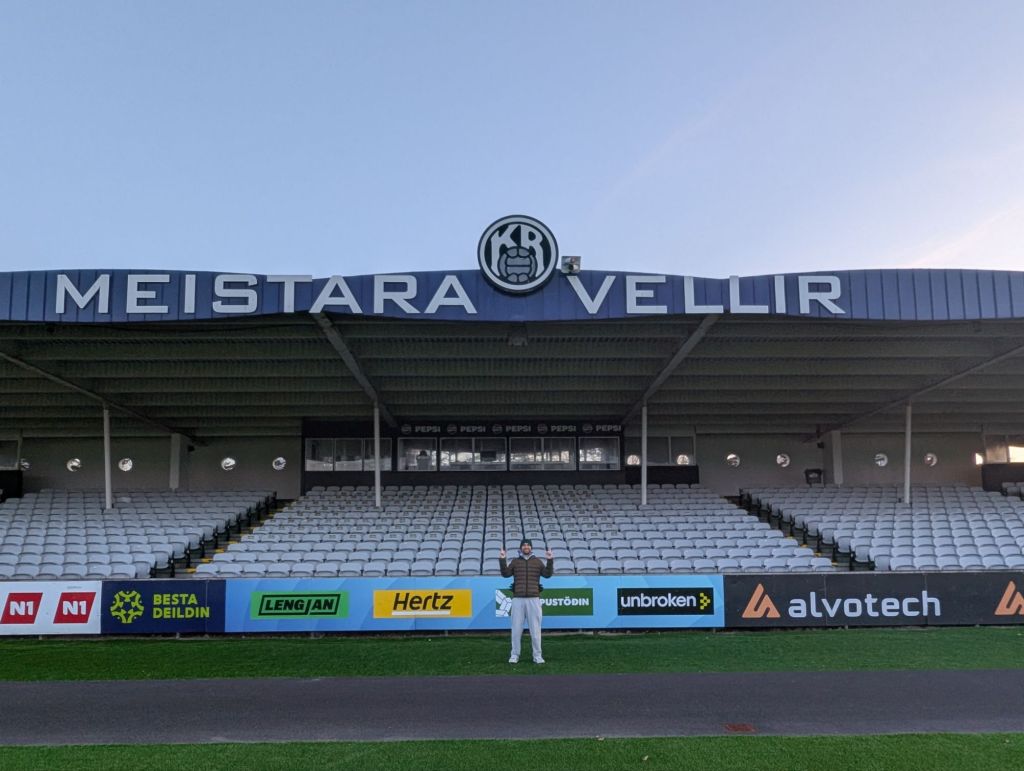
I walked over to the main stand — Meistaravellir (Master’s Fields), naturally — and instantly pictured matchday: the press box humming, the ‘dugouts’ (not dug into anything at all), and the roar of 2,700 supporters I’ve christened the KRew. Black‑and‑white scarves aloft, optimism eternal. My inner child nearly staged a full‑blown goal celebration, shirt over the head, sprint to the corner flag included.
And just when I thought my pilgrimage had peaked, I turned and saw something greater: the local kids already on their own journeys. Dozens of them, in KR black and white and the colours of other clubs, united in pure football joy — passing, shooting, celebrating, tumbling, bouncing back, and (whether they knew it or not) writing the next chapter of KR mythology. They played on a surface I never imagined I’d set foot on, yet for them it was the launchpad to futures still unwritten — footballers, geologists, chain‑saw operators, whatever destiny decides. The digital ground that entertained me for so long was here in real life, now providing joy, opportunity, and the chance for these kids to become whoever they want to be.
I then had one of those moments in life that feel scripted, as if fate left a prop waiting for you to pick up. On the left side of the pitch, I found a ball someone had abandoned — scuffed, ordinary, but charged with possibility. I stepped up, and in full Sensible Soccer / Hilmar Björnsson homage, curled it into the far post. The strike wasn’t just a kick, it was a bridge between eras of my own life.
“Bowditch picks up the ball on the left flank… curls it… a hint of after-touch… YES! Off the far post! Sensible Soccer glory reborn! Hilmar Björnsson would be proud!”
In that instant, my younger and older selves shook hands — emotionally, spiritually — as if the pixels of my childhood had merged with the grass under my boots. A bucket‑list goal achieved, not in front of thousands, but in front of the only audience that mattered: me, across time. It wasn’t about the scoreboard. It was about honouring the game that shaped me, the digital echoes that taught me imagination, and the real‑world strike that stitched them together.
On the way out, I stumbled into the world’s finest club shop — an Emerald City of polyester, where loyalty is measured not in decibels but in the flex of one’s credit card. The shirt was £100, a sum so grotesquely inflated it felt like Dorothy’s tornado had picked up my bank account and hurled it into Kansas, leaving me clutching Toto and a receipt for financial ruin.
Even true love has fiscal boundaries, and mine stopped short of funding the chairman’s next South Stand via a garment stitched for pennies in a far‑flung sweatshop. So I settled for a scarf at £30. Still extortionate, but at least it felt like I’d escaped the Wicked Witch’s ransom with only a dented wallet and the faint smell of polyester smoke. I’m wearing it now, a symbolic thread tying together the teenager I was and the adult I’ve become — proof that nostalgia can be weaponised, and that even in football’s Emerald City, the Wizard behind the curtain is less a benevolent conjurer than a cash register with delusions of grandeur.
And so the pilgrimage ended not with fireworks, but with a scarf, a free car park, and the quiet knowledge that sometimes the Emerald City is just a football ground in Reykjavík. The wizard wasn’t hiding behind a curtain — he was a coach in a tracksuit, a kid scoring on astroturf, a community that refuses to let the magic die.
I clicked my metaphorical ruby slippers, and instead of Kansas, I found myself exactly where I needed to be: home, in black and white, with Hilmar Björnsson still running rampant in my imagination. KR, you are proof that the games we play on screens are only half the story — the other half is here, alive, and louder than any pixelated crowd could ever be.

 Lore: Building an Empire, One Pixel at a Time
Leave a comment